
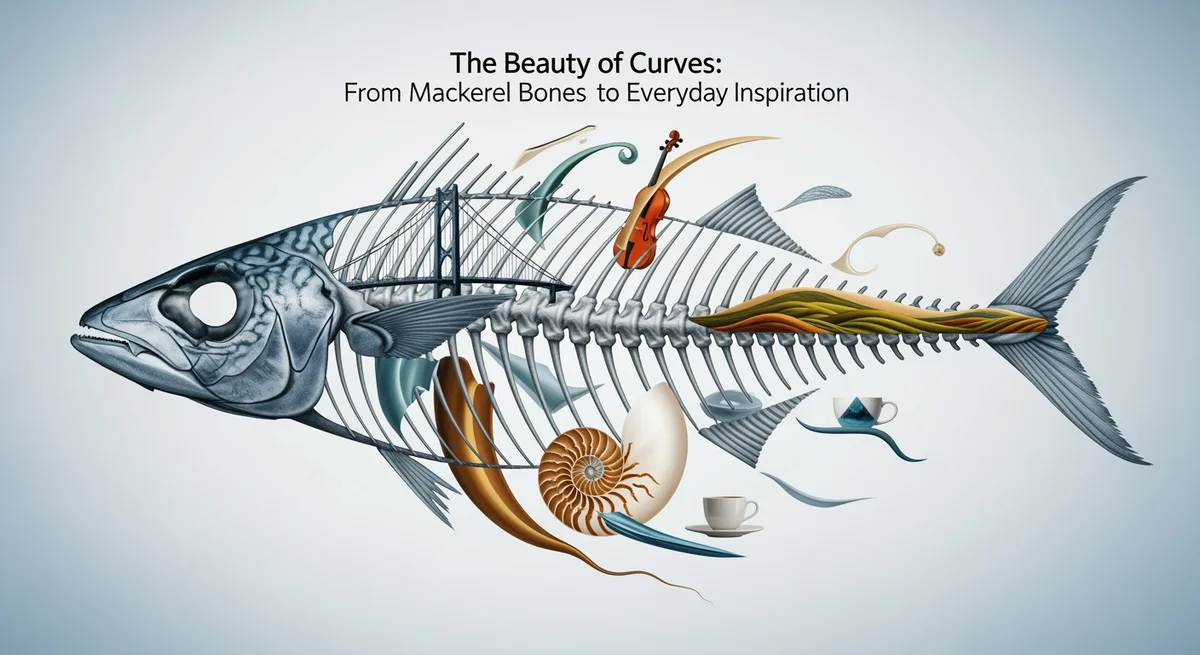
The Beauty of Curves: From Mackerel Bones to Everyday Inspiration

Finding Wonder in the Ordinary: The Mackerel Bone Moment
There's a beautiful, quiet moment in the animated film The Wind Rises that resonates deeply with anyone who's ever found profound inspiration in the seemingly mundane. The protagonist, Jiro Horikoshi, sits in a local eatery, enjoying a simple plate of Saba no Misoni, mackerel simmered in miso. As he finishes his meal, he gazes intently at the leftover mackerel bone. To anyone else, it’s just a discarded relic of dinner, but to Jiro, it’s a revelation: the perfect aerodynamic curve, a natural blueprint for an aircraft wing.
This scene isn't just about aviation; it's a testament to the observant eye, the passionate heart of a creator who sees beyond the obvious. It reminds us that great ideas often hide in plain sight, waiting for us to slow down, truly look, and appreciate the natural artistry that surrounds us, even at the dinner table.
Nature's Masterpiece: The Efficiency of Curves
The curve of a mackerel bone, a bird's wing, the arc of a wave – these aren't random. They are the result of countless generations of natural selection, optimized for efficiency, strength, and grace. Nature is the ultimate engineer, and its designs are inherently beautiful because they are inherently functional.
Think about it: Why are so many natural forms curved? Curves distribute stress evenly, allowing for strength without excess material. They reduce drag, making movement through air or water more efficient. From the spiral of a snail shell to the gentle slope of a mountain, curves are fundamental to the natural world's elegance and endurance.
The Kitchen as a Classroom for Creativity
The kitchen, often seen as a place of routine and sustenance, is in fact a vibrant laboratory of natural design and practical ingenuity. Every ingredient, every utensil, every cooking technique holds a lesson. Consider the spiral of a red cabbage when cut in half, the intricate network of veins in a leafy green, or the perfect sphere of a dewdrop on a herb. These are not just ingredients; they are miniature masterpieces of form and function. Cooking itself is an act of transformation, of understanding how different elements interact, much like an engineer understanding stress points or an artist understanding composition.
Observing the elegant curve of a banana peel, the way a pasta shell holds sauce, or the fractal patterns in broccoli isn't just a whimsical exercise. It trains our eyes to see detail, to appreciate the underlying structures that make things work, and to draw parallels to challenges in our own creative or professional lives. The kitchen becomes a space where we can hone our observational skills and cultivate a mindset that seeks inspiration everywhere.
Cultivating Your Own 'Mackerel Bone Moment'
Jiro's moment with the mackerel bone wasn't a one-off stroke of luck; it was the culmination of a deeply curious mind, constantly seeking solutions and patterns. We can all cultivate this kind of observant awareness. Whether you're a writer grappling with a plot, a designer sketching a new product, or simply navigating daily life, pause. Look closely at the world around you. What seemingly insignificant detail holds a hidden lesson? What natural form offers an elegant solution to a problem you're facing?
The next time you're cooking, eating, or simply walking through your day, remember the mackerel bone. It's a humble reminder that the most profound insights often emerge when we allow ourselves to truly see, to wonder, and to appreciate the quiet, inherent genius of the everyday. The world is brimming with blueprints for beauty and innovation, if only we take the time to notice.