
Mastering the J-Fold: The Secret to Light and Airy Batters

Unlock the Air: The Magic of the J-Fold Technique
If you've ever embarked on a baking adventure that involves delicate mixtures like meringue, whipped cream, or soufflé bases, you've likely encountered the gentle, almost whispered instruction: "fold gently." But what does 'gently' really mean when you're trying to combine two distinct mixtures without deflating all that beautiful air you've worked so hard to incorporate? The answer, for many seasoned bakers and certainly for me, lies in mastering the J-fold.
This seemingly simple movement is, in fact, one of the most reliable techniques for achieving those coveted light and airy textures in your cakes, mousses, and soufflés. It's about precision and patience, and once you get the rhythm, it truly becomes second nature.
Why 'Gently' Matters: The Science of Air
Baking is as much an art as it is a science, and understanding the role of air is fundamental to success, especially with delicate batters. Ingredients like egg whites, when whipped, create a stable foam that traps countless tiny air bubbles. These bubbles are the magic behind lift and lightness; they expand in the oven, giving cakes their rise and airy crumb.
When you combine a light, airy mixture (like meringue) with a heavier one (like a cake batter), the goal is to integrate them thoroughly without popping those precious air bubbles. Aggressive stirring or mixing will collapse the foam structure, leading to dense, heavy results – the exact opposite of what we're aiming for. The J-fold is designed to minimize this impact, preserving the airy texture and ensuring your baked goods are wonderfully light.
Deconstructing the J-Fold: A Step-by-Step Guide
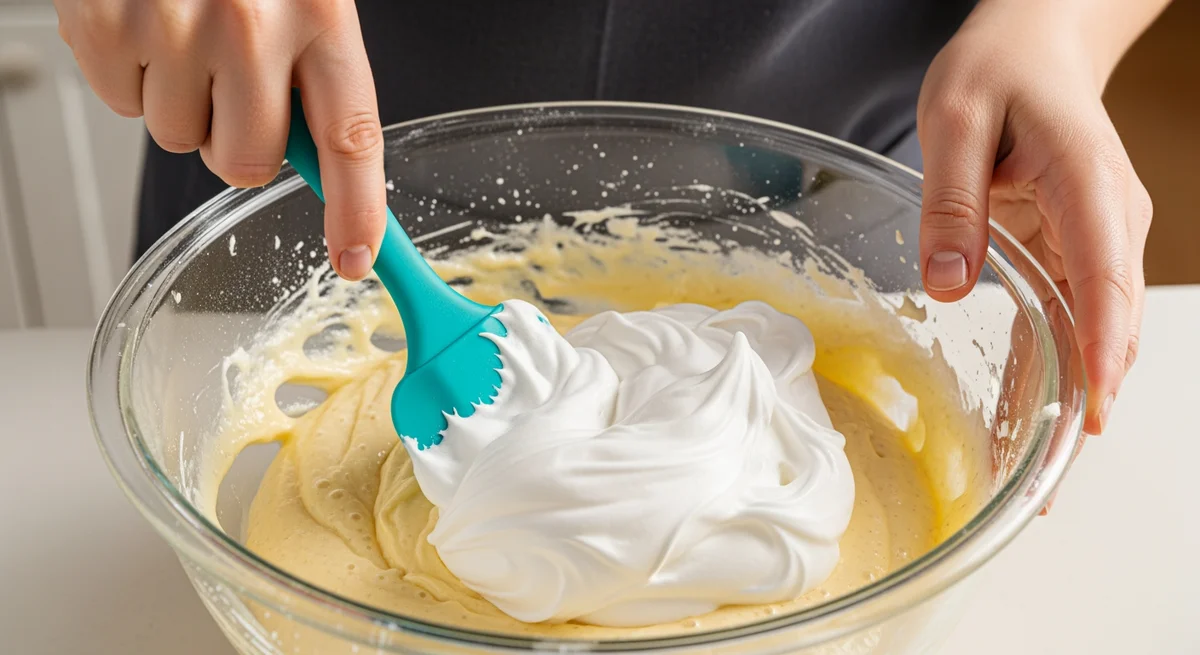
The J-fold gets its name from the motion of your spatula, which resembles the letter 'J'. It's a systematic approach that ensures even incorporation without overworking the batter. Here’s how you do it:
-
Gather Your Tools: You'll need a large, flexible rubber spatula – often called a 'scraper' or 'folding spatula' – and a wide, shallow bowl for easier manipulation. A wide bowl gives you more surface area to work with.
-
Add Your Lighter Mixture: Gently spoon about
1/3of your lighter mixture (e.g., meringue) over your heavier base batter. -
The Cut-Through: Hold your spatula vertically, with the blade facing the center of the bowl. Insert it into the batter, slicing down through the center of the bowl, all the way to the bottom.
-
The Scoop: Once your spatula reaches the bottom of the bowl, turn your wrist and sweep the spatula across the bottom towards the edge of the bowl farthest from you. Scoop up a portion of the heavier batter, bringing it up and over the lighter mixture.
-
The Fold (The 'J' Motion): As you bring the scooped batter up, gently fold it over the top of the lighter mixture, essentially creating the top curve of the 'J'.
-
Rotate and Repeat: Rotate the bowl about a quarter turn (or
90degrees) and repeat the cut-through, scoop, and fold motion. Continue this process, turning the bowl after each fold, until the two mixtures are just combined. You're looking for a homogenous mixture, but don't overdo it.
Pro Tip: Visualize a clock face. You're sweeping from 6 o'clock, up to 12 o'clock, and then folding over. Rotate the bowl and repeat.
Common Pitfalls and How to Avoid Them
As a recipe developer, I've seen firsthand that the biggest mistake bakers make when folding is being too aggressive. It's easy to fall into the trap of stirring or pressing the batter, especially when you want to ensure everything is mixed. But remember, every forceful stir is a potential bubble burst!
- Over-mixing: The number one enemy. Stop folding as soon as no streaks of either mixture remain. A few small lumps are far better than a deflated batter.
- Small Bowl Syndrome: Trying to fold in a bowl that’s too small makes it harder to execute the J-fold properly without squishing the mixture. Opt for a generous-sized bowl.
- Wrong Spatula: A stiff, inflexible spatula won't allow for the gentle scoop and fold. A soft, flexible rubber or silicone spatula is key.
- Lack of Rotation: Simply stirring in one spot will lead to uneven mixing. Consistent rotation of the bowl is crucial for thorough incorporation.
The Smart Start: Loosening the Batter First
Here’s a trick I always employ that makes the J-fold even more forgiving: start by loosening your heavier batter. When you're combining a delicate meringue with a thick, dense base, the initial folds can be quite difficult and prone to deflating the meringue. To counteract this, take a small portion—about 1/4 or 1/3—of your lighter mixture (e.g., meringue) and mix it aggressively into your heavier batter.
Yes, you read that right – aggressively! This initial mixing will sacrifice a small amount of the lighter mixture’s air, but its primary purpose is to lighten the heavier batter, making it much easier to fold in the remaining delicate mixture. It essentially brings the two components closer in consistency, allowing for a much smoother and less damaging final fold.
Once the base batter is lightened, then you proceed with the true, gentle J-fold technique for the rest of the delicate mixture. This simple step can dramatically improve the final texture of your baked goods.
Where the J-Fold Shines Brightest
The J-fold isn't just for advanced bakers; it's a fundamental skill that applies to a wide range of recipes where lightness is paramount. You'll find yourself reaching for this technique again and again in:
- Chiffon Cakes: Known for their incredibly light and airy crumb, chiffons rely heavily on properly folded egg whites.
- Sponge Cakes (Genoise, Angel Food, Roulades): These cakes are all about whipped eggs or egg whites, and the J-fold ensures that air is preserved.
- Mousses: Whether chocolate, fruit, or savory, mousses derive their ethereal texture from gently folded whipped cream or egg whites.
- Soufflés: The impressive rise of a soufflé is entirely dependent on the air trapped in the egg whites and how carefully they are folded into the base.
- Macarons: While slightly different, the 'macaronage' process shares the same principle of gently folding to achieve the right consistency without deflating.
Practice Makes Perfect
Like any skill, mastering the J-fold takes a bit of practice. Don't be discouraged if your first attempts aren't perfectly light. Pay attention to the feel of the batter, the rhythm of your spatula, and the appearance of the mixture. Soon, you'll develop an intuitive understanding of when the batter is perfectly combined – not too much, not too little.
The J-fold isn't just a step in a recipe; it's an art form that transforms good baked goods into truly exceptional ones. Embrace the gentle motion, trust the process, and get ready to enjoy the delightfully light and airy results of your efforts!