
Beyond the Blender: The Ancient Art of Emulsification for Perfect Froth and Mouthfeel

The Lure of Lassi: More Than Just a Drink
There's something truly magical about a perfectly made Lassi. This beloved Indian yogurt drink offers a unique experience – that creamy, yet light, frothy texture is simply divine. But have you ever wondered why some Lassis boast a cloud-like froth and an incredibly smooth mouthfeel, while others fall a bit flat?
It often comes down to one crucial technique: emulsification, and how it's achieved. While modern blenders promise speed, traditional hand-churning, especially with a tool called a Madhan, holds the secret to Lassi's superior texture.
Understanding Emulsification: The Science of Smoothness
Simply put, an emulsion is a stable mixture of two liquids that don't normally mix, like oil and water. In Lassi, the 'liquids' are primarily water and milk fat from the yogurt. A great Lassi is a beautifully integrated suspension where tiny fat globules are evenly dispersed throughout the liquid. This dispersion, combined with incorporated air, gives Lassi its characteristic richness without being heavy.
The Madhan Magic: A Gentle Embrace of Ingredients
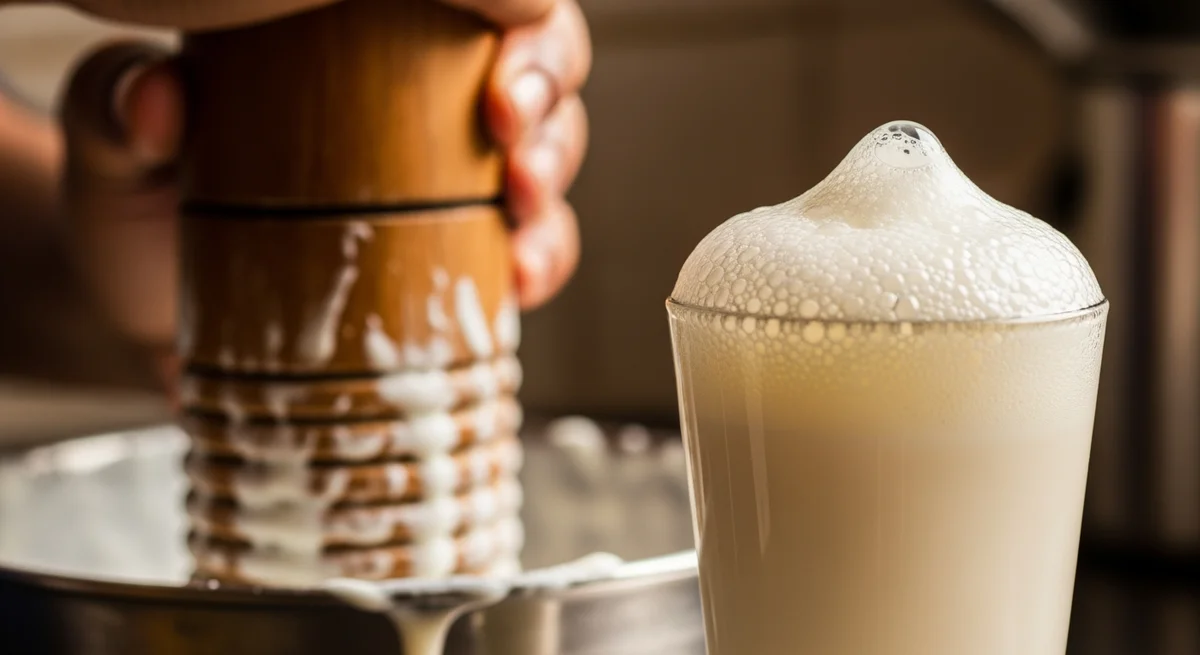
Imagine a wooden churner, often with a daisy-like head, used with a rhythmic, back-and-forth motion. This is the Madhan (sometimes called a mathani), a tool used for centuries to make Lassi. Its approach to emulsification is fundamentally different from a high-speed blender.
The Madhan works by gently agitating the yogurt mixture, creating a gradual and controlled process:
Gentle Shearing: The Madhan's blades subtly break down larger fat globules into smaller, more uniform sizes. This is a patient separation, not a violent pulverization.
Stable Air Incorporation: With each rotation, the Madhan subtly folds air into the mixture. Because the action is less aggressive, the air bubbles created are generally smaller and more stable.
Protein Interaction: This slow, steady motion allows the yogurt proteins to partially denature and form a stable matrix around the fat globules and air bubbles. This creates a remarkably stable emulsion.
The Result: This gentle, methodical process is key to the Madhan's superiority. It creates a thick, long-lasting layer of froth with small, uniform air bubbles that don't dissipate quickly. The consistently fine suspension of fat globules also results in an incredibly smooth and velvety mouthfeel that coats the palate deliciously.
The Blender Battle: Efficiency vs. Elegance
Modern blenders are fast and convenient, but for Lassi, their high-speed, aggressive blades can be a drawback:
Violent Shearing: Blenders operate at very high RPMs, which can over-shear fat globules, potentially creating an emulsion that's too fine or even breaking it.
Large, Unstable Air Bubbles: The rapid action whips a lot of air in quickly, but these bubbles are often larger and less uniformly sized. They create an impressive initial froth that tends to be less stable and dissipates much faster.
Heat Generation: High-speed blending generates heat, which can affect yogurt proteins and destabilize the emulsion, leading to a thinner Lassi and less enduring froth.
The Takeaway: While a blender makes Lassi quickly, it often results in a thinner drink with fleeting froth and a less luxurious mouthfeel compared to its hand-churned counterpart. It's efficient, but it lacks the finesse.
Achieving Lassi Bliss (Even Without a Madhan)
Don't despair if you don't have a Madhan! You can still get closer to that perfect texture:
Use a Whisk or Immersion Blender: These offer a gentler approach than a powerful jug blender. Use a back-and-forth or up-and-down motion.
Short Bursts, Low Speed: If using a regular blender, use a lower speed setting and blend in very short bursts (5-10 seconds), pausing between. This mimics the Madhan's gentler action.
Cold Ingredients are Key: Always start with very cold yogurt and water/milk to help maintain emulsion stability.
The 'Pouring' Trick: After blending, pour your Lassi back and forth between two glasses from a height a few times. This simple act can build a nice, stable frothy head without over-blending.
Get the Recipe for Namkeen Lassi
Embracing the Art of the Slow Stir
In our fast-paced world, the humble Madhan reminds us that sometimes, the best results come from patience and a hands-on approach. The superior froth and silky mouthfeel of a traditionally hand-churned Lassi aren't just accidents; they're the direct result of a nuanced understanding of emulsification and the gentle art of working with ingredients. So, next time you crave Lassi, consider slowing down and savoring the process – your taste buds will thank you!