
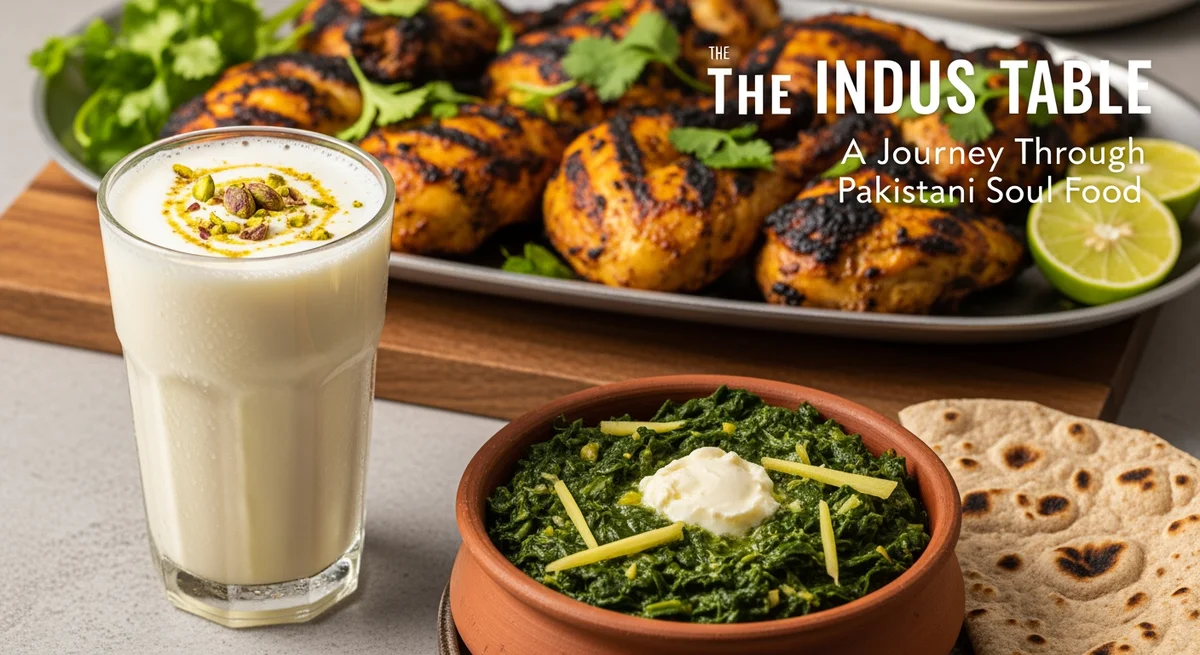
The Indus Table is a masterclass in the intersection of heritage and health. Written by a food scientist and academic, this collection reclaims Pakistani "soul food" from the heavy, oil-laden stereotypes of global takeout. By deconstructing the chemical architecture of traditional techniques—like the Bhuna and the Tarka—this book offers a professional yet accessible blueprint for nutrient-dense, vibrant, and authentic meals. It is a journey to the heart of the Indus Valley, where ancient wisdom meets modern nutritional science.
About This Cookbook
The Laboratory of the Soul Food in the Indus Valley was never meant to be "heavy." It was designed to be functional. As a professional my days are often spent in the world of molecular structures, thermal denaturation, and nutrient bioavailability. But my mornings? My mornings have always belonged to the scent of caramelizing onions in a Karahi and the rhythmic, hollow sound of a wooden madhan churning fresh yogurt into Lassi. The Indus Table was born from a simple realization: the traditional Pakistani kitchen is, and always has been, a sophisticated laboratory. The Inspiration: Beyond the Grease For too long, the global perception of Pakistani cuisine has been filtered through a narrow lens of deep-fried appetizers and heavy, oily curries. I wrote this book to bridge the gap between the "Soul Food" of my childhood and the "Food Science" of my career. I wanted to show that our ancestors were intuitive scientists. They understood that the sulfur in black salt aids digestion, that the acidity of a plum chutney emulsifies fats, and that a high fiber-to-protein ratio in a Shami Kebab isn't just a culinary preference—it’s a strategy for satiety and health. Memories of the Indus My earliest memories are not of recipes, but of textures and reactions. I remember watching my grandmother dry out the moisture from lentils for kebabs until they reached a specific fiber-thread consistency—what I now recognize as the perfect structural matrix for protein. I remember the sharp, zingy aroma of Chaat Masala hitting a bowl of fresh fruit, a sensory explosion that taught me more about flavor balance than any textbook ever could. This book is an homage to those moments. It’s for the rainy afternoons in Lahore when only a spicy Khagina will do, and for the humid summer days when a chilled, salted Lassi feels like a physiological reset. Who is this book for? For the Global Home Cook: Who wants the bold, unapologetic flavors of Pakistan without the "food coma" that often follows. For the Health-Conscious Foodie: Who looks for high-protein, nutrient-dense meals that don't compromise on soul. For the Student of Flavor: Who wants to understand the why—why we temper spices, why we steam our dumplings, and why we use the clay of the earth to cook our bread. Welcome to my table. It is simple, it is direct, and it is rooted in the basics. Let us begin at the foundation.
