
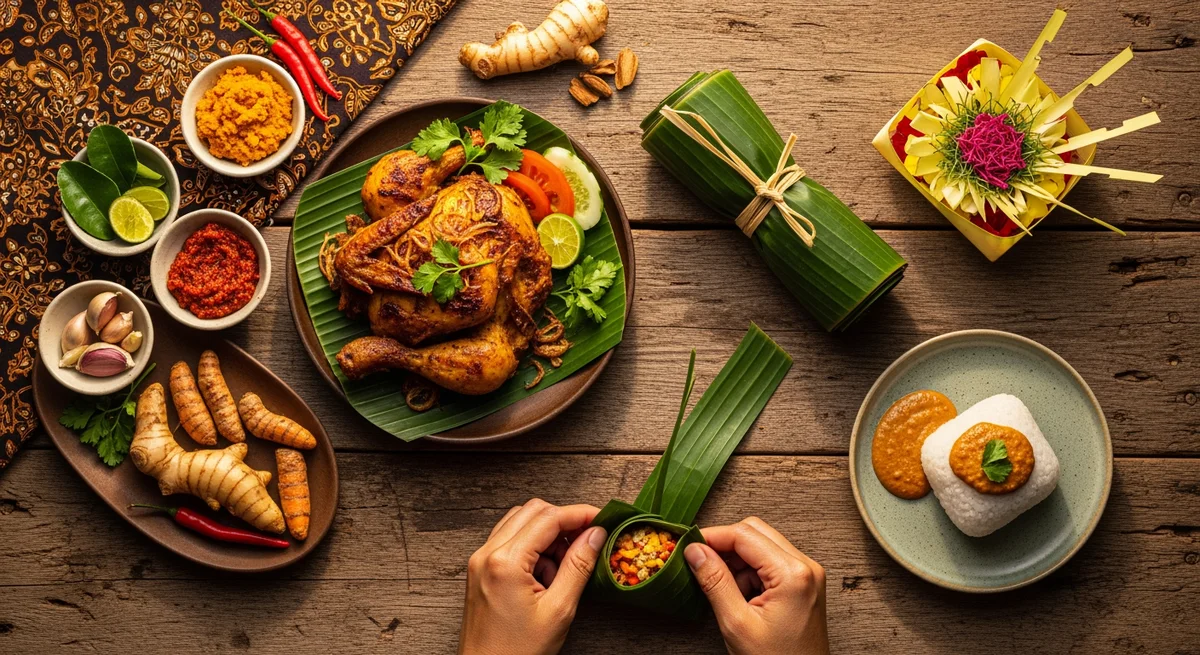
A collection of 20 authentic Balinese recipes from the island of the gods — from sacred ceremonial dishes like Ayam Betutu to beloved street food like Tipat Cantok. Written by a Balinese culinary student, this cookbook celebrates the spice pastes, banana leaf techniques, and rich cultural traditions that make Balinese cuisine one of the most vibrant in Southeast Asia.
About This Cookbook
I was born and raised in Bali, on an island where cooking is not just about feeding people — it is about honoring the gods, gathering family, and keeping traditions alive. My earliest memories are of my mother's kitchen: the sound of a stone mortar grinding base genep before dawn, the smell of banana leaves warming over an open flame, and the golden color of turmeric staining everything it touched. In my family, every dish tells a story. My mother learned to make Ayam Betutu from my grandmother, who learned it from hers — the same spice paste recipe, the same banana leaf wrapping technique, the same overnight cooking method passed down through generations. Sambal Matah was never measured with spoons but with instinct — a handful of shallots, a squeeze of lime, "just enough" chili. Lawar was made together as a family before every temple ceremony, everyone with a job: someone grating coconut, someone slicing long beans impossibly thin, someone tending the fire. Growing up in Bali, I never realized how special this was. Every house smelled the same way in the morning — base genep and coconut oil. Every ceremony meant the same beloved dishes appearing on banana leaf-lined trays. Every warung on every corner served the same Nasi Campur that tasted completely different because every Ibu had her own secret. This cookbook is my love letter to Balinese home cooking — the real food that Balinese families eat every day and prepare with devotion for every ceremony. These are not restaurant recipes or tourist versions. These are the dishes my mother made, the snacks I bought from morning market vendors on my way to school, and the ceremonial foods that connect my family to our faith and our ancestors. This cookbook is for anyone who wants to taste Bali — not the Bali of beach clubs and smoothie bowls, but the Bali of village kitchens, morning markets, and family temples. I hope these recipes bring a piece of my island into your home. With love from Bali, Fara
Contents(20 recipes)
Foundations — Sambals & Staples
Morning & Street Food
Everyday Balinese Dishes
Ceremonial & Feast Dishes
Light Bites, Sweets & Drinks
The Heart of Balinese Cooking
"Balinese cooking is not about perfection — it is about presence. Be present when you grind the spice paste, be present when you wrap the banana leaf, be present when you feed the people you love. The food will taste like however your heart feels when you make it." — A Balinese grandmother's advice to her granddaughter
How to Use This Cookbook
This cookbook is organized from simple to complex — starting with the foundational sambals and staples that appear on every Balinese table, moving through the beloved street food and everyday dishes, and finishing with the grand ceremonial feasts and sweet treats. Many recipes share the same base genep spice paste, so once you master that foundation, every other dish becomes easier. I recommend starting with Sambal Matah and Nasi Jinggo to build your confidence, then working your way up to Ayam Betutu when you are ready for a beautiful challenge. Most importantly, do not rush — Balinese cooking rewards patience.
The Three Tools Every Balinese Kitchen Needs
You do not need fancy equipment to cook Balinese food — just three things. First, a stone mortar and pestle (cobek batu) for grinding spice paste. A food processor works, but the mortar gives a better texture and releases more aromatic oils. Second, banana leaves — buy them fresh or frozen from any Asian grocery store. They are your wrapping, your steaming vessel, and your serving plate all in one. Third, a sharp knife and a steady hand for slicing shallots, lemongrass, and kaffir lime leaves paper-thin. Balinese cooking is about fresh ingredients prepared with care, not expensive kitchen gadgets.
Why I Wrote This Cookbook
When I started culinary school, I studied French techniques, Italian pastas, and Japanese knife skills. I was so focused on learning "international cuisine" that I almost forgot the most extraordinary cuisine was already in my own home — in my mother's kitchen, in my grandmother's recipes, in the warung down the street where I ate Nasi Campur every afternoon. One day a classmate from Jakarta asked me, "What makes Balinese food different from the rest of Indonesia?" and I realized I could not fully explain it. That question changed everything. I went home and started cooking with my mother — really paying attention this time, writing things down, asking why she adds the kencur at that exact moment, why she wraps the banana leaf in three layers not two. This cookbook is everything I learned when I finally stopped looking outward and started looking at what was always right in front of me.
